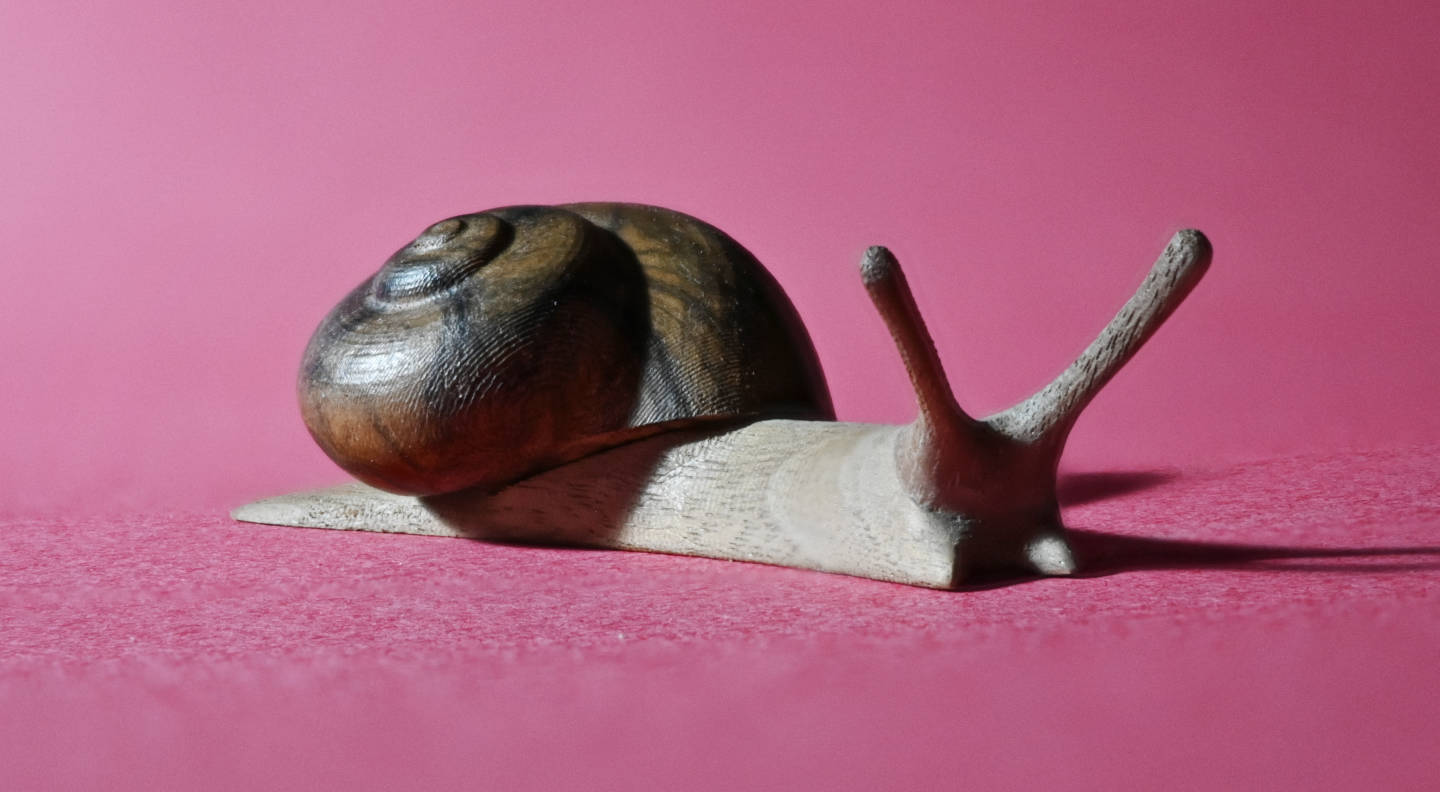
Snail Box
I wrote this in March this year, but for some reason didn't post it. I had a few things on my mind and dealing with all the images and descriptions just felt a bit much. I've done several projects since this one but didn't want to just forget what I'd written. Besides, I think the snail is cute. So… from March:
I've had more free time since leaving my last job role and wanted to use it to learn new things. I renovated the workshop last year and got some new equipment, but I haven't learned how to use it all fully yet. I needed a project to make something that would challenge me and make me try new things. It would need to be an actual recognisable thing, and it would need to feel satisfying once made, and it would need to be difficult but not insurmountably so.
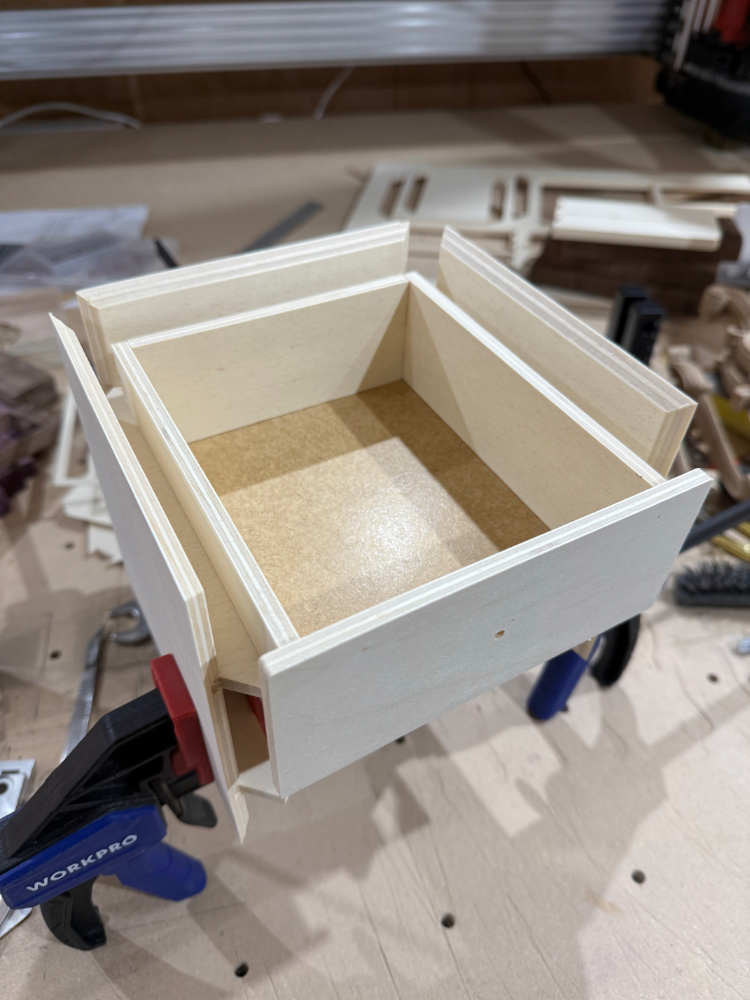
So, a box. With drawers. I've made a box with a single drawer before, so… two drawers, that would need to line up and look neat, and use runners rather than be the 'shelf' type. It would need something carved so I learn that skill, both machine and by hand — that would mean learning modelling tools and CNC tools, as well as hand finishing. It would also need to combine carving with clean lines, because I felt the carving could hide errors but clean lines can't.
Sketching and thinking
I have all these lovely sketchbooks but I always end up reaching for the box of square notes. Something about how small and disposable they feel, it makes it easier to do rough sketches.
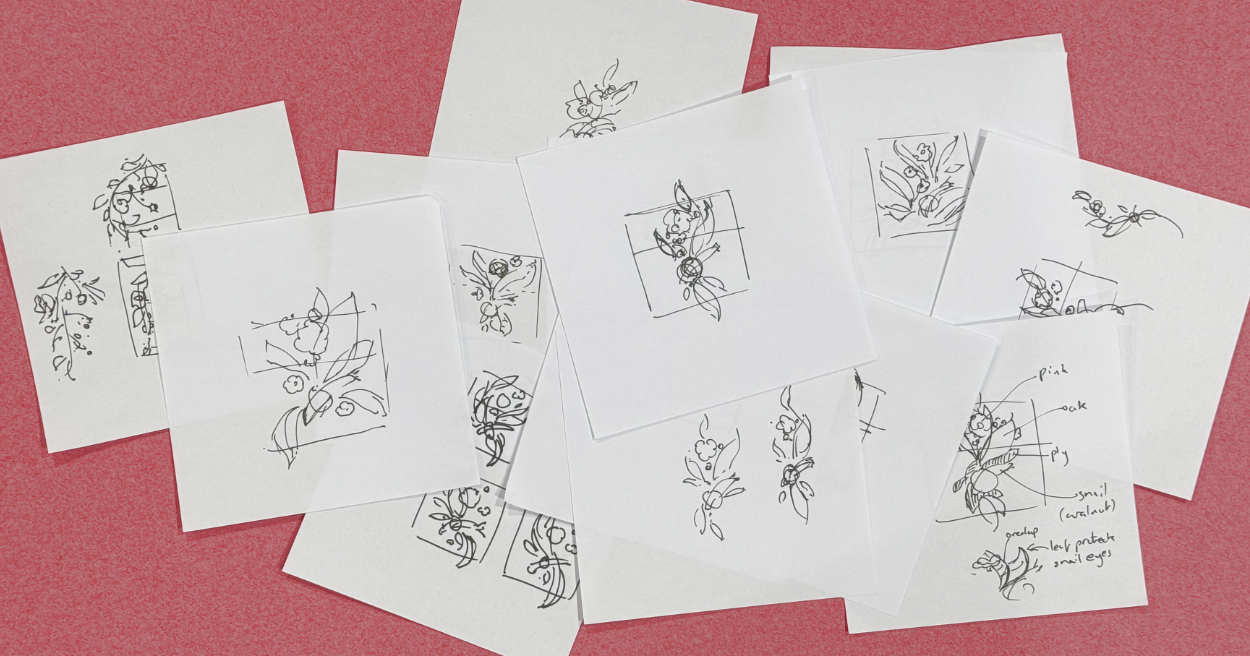
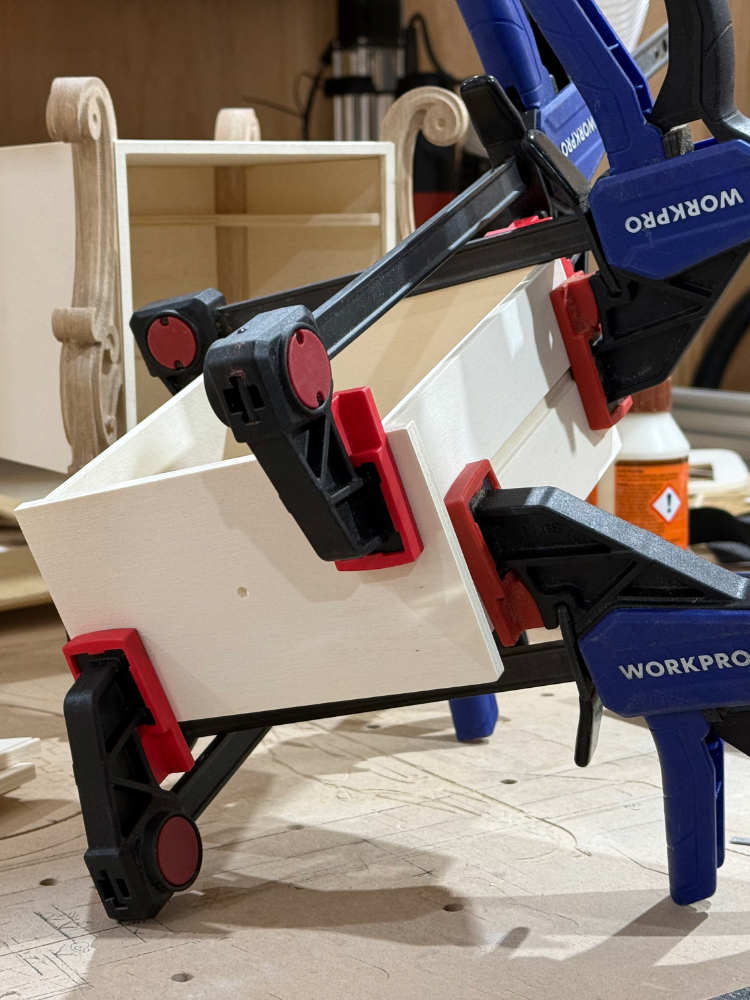
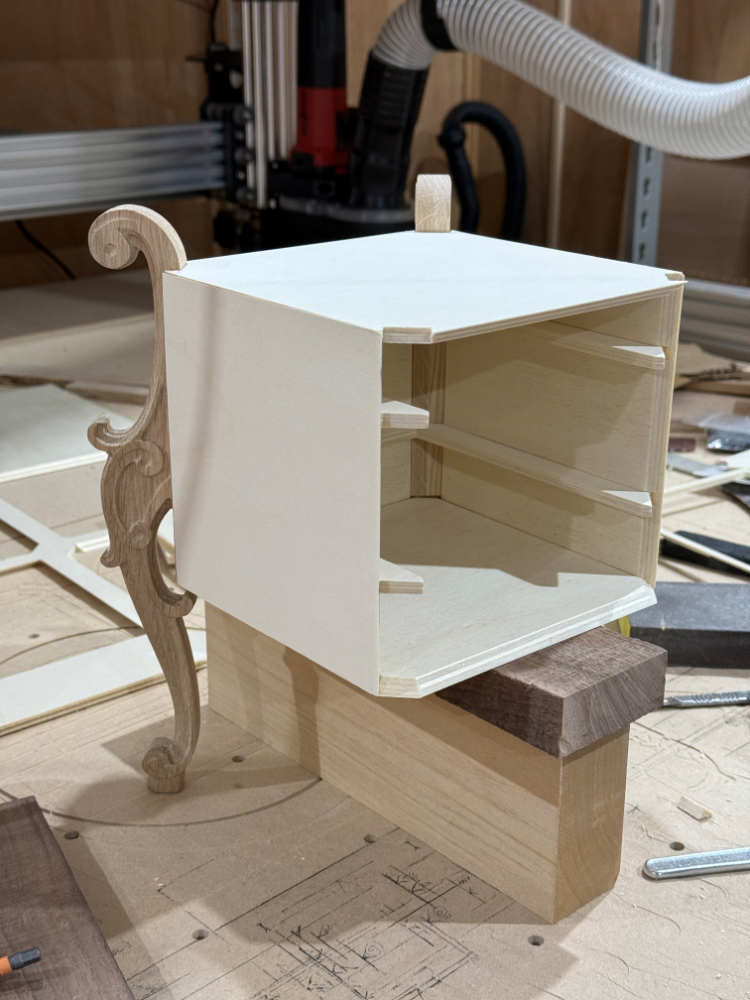
My original thought was a plain white box with fancy rococo legs. The legs would be attached diagonally at the corners, adding to the difficulty and needing some extra planning and calculation on box construction and how the drawer runners would work.
Legs!
Fancy rococo legs, eh.
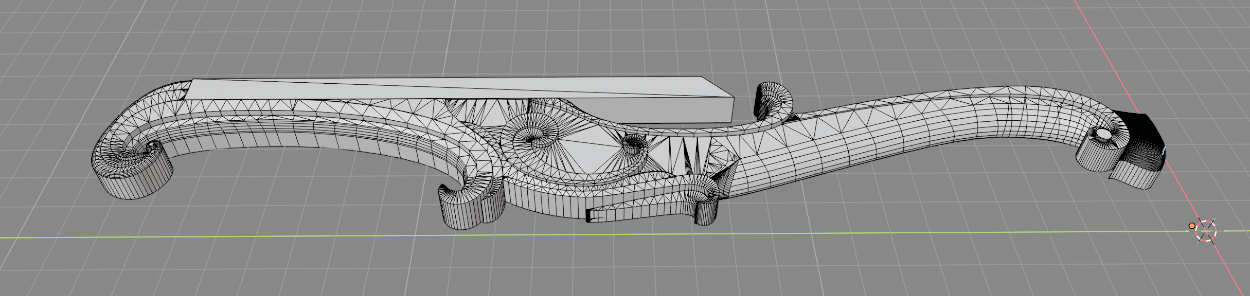
I've used 3D tools on and off over the years, I've used Sketch a fair bit too. This felt like something I'd need to learn some actual proper 3D modelling with. So often I've said, "I should learn Blender", and now, I have something to actually make with it.
It didn't start too well, but thanks to internet tutorials (yes, including the donut one) I got somewhere with it:
I have used Blender, and made a thing. Yesterday I was "It won't even let me select a fucking FACE" and today I imported the thing into VCarve and hopefully will cut it out of oak tomorrow.
That turned out to be a little optimistic, but genuine progress had been made.
The issue, and it continues to be an issue with everything to do with CNC making, is that you're using natural materials with power tools that are… powerful. The natural materials need to hold together and stay where they are while powerful motors shove a 1000W milling motor with spinning sharp bits of metal through it. When it works you feel on top of the world, when it doesn't you feel like you'll never figure this out and all you're doing is making sawdust and broken wood (and broken carving bits).
A big part of the problem is the fact I set myself a challenge. With CNC I quickly figured out cutting shapes to make simple boxes and so on. That works fairly reliably. But what I'm doing is carving specific shapes that need to have precise cuts to join up with the rest of the box, while being smooth and flowing for the decorative outward facing bits. Also, I need to carve multiple copies and have them all the same.
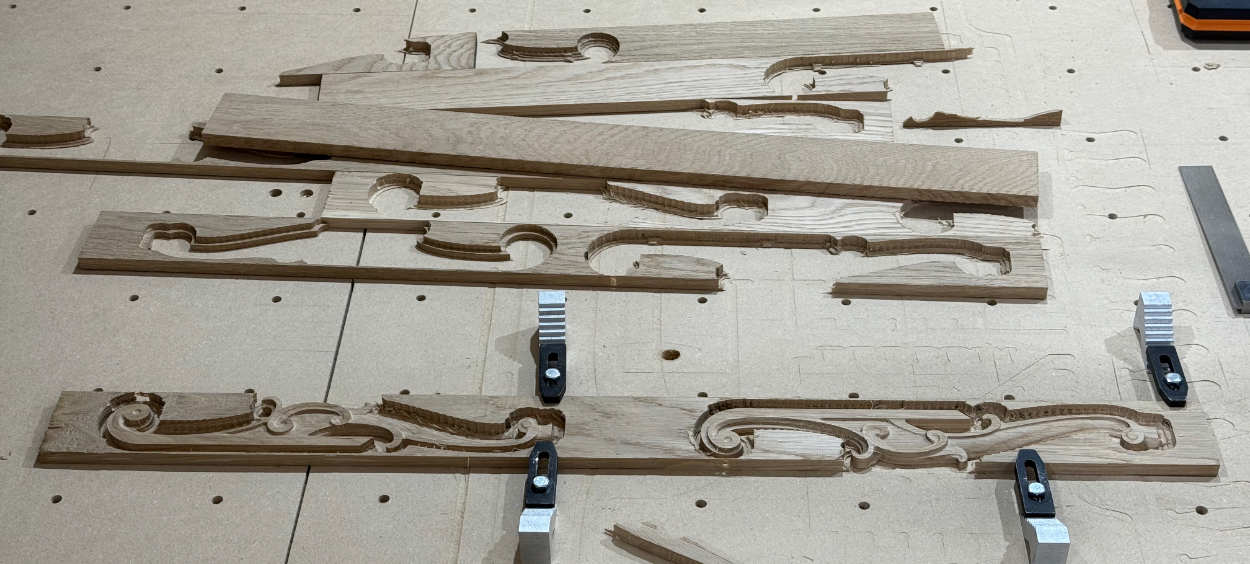
I have lots of broken bits of oak, and I have some almost-there bits of legs. Eventually I figured it out enough to get eight leg-halves that I could glue together.
Why leg-halves? Well the oak I had was a box of offcuts (thrifty!) that were various lengths, 10cm wide and 1cm thick. I wanted legs a bit thicker than that, and to simplify the process in VCarve, I decided to cut out the front and back of each leg separately and glue them together.
A note on VCarve
CNC machining is based largely on a thing called G-code. It's a set of instructions to tell the machine where to move. You can theoretically write G-code yourself, but to do that for a complex 3D model… no. No one would do that. So, you need some software to do it.
I had looked at some options, mostly open source or free, or cheap. I tried a couple. Oh dear. If I'd struggled with Blender… ha ha. So, I spent some money. The CNC machine cost a bundle, and I guess the software to make best use of it does too. I bought Vectric VCarve Pro. It lets you import 3D models, it has settings for my machine (Ooznest Z1+) and, importantly, made sense to me when I started using it. I've had to follow a couple of tutorials to learn some features, but generally I've been impressed. No, I'm not paid by them (sadly) but it is good software.
Something it does that I could have used for making these box legs is two-sided cutting. You set up a cut, and can flip the piece over and have it cut the other side. It's handy for 3D models where you want to carve both sides. The issue, as ever, is making sure the piece stays where it is. You need to leave uncut areas around the edge (called tabs) so that you don't cut the piece completely out mid-carve and it end up flying off and breaking. I have had this happen, even with tabs, and it sucks. The noise is terrifying. (Edit: much later, I have learned so much about this process, there is tape, and there are dowels, absolutely vital)
Knobs.
I was going to have the drawer pulls be simple knobs. Then, I was thinking that wasn't much of a challenge, so the knobs should be carved. But what of? I wanted to stay within the rococo theme for the legs, so something floral maybe. But rococo decor often creates a scene. A snail, and a flower.
This is actually something I did purely for the challenge of making it. The box would look better without the ornamental bits on the drawers, but doing this taught me loads, so it was worth it.
Shells
A snail. Now there's a challenge. I went hunting round the garden for snail shells and found a few. I also have lots of photos of snails I'd taken over the years.
Snail shells are fascinating things. The shell spirals out, helixes up, and curves over. I learned a fair bit about Blender with that, and got a few reasonable snail shells modelled. I've learned more since then and would probably do a much neater job of it. I ended up with a whole load of messy internal geometry that limited what I could do with it, but I got there in the end.
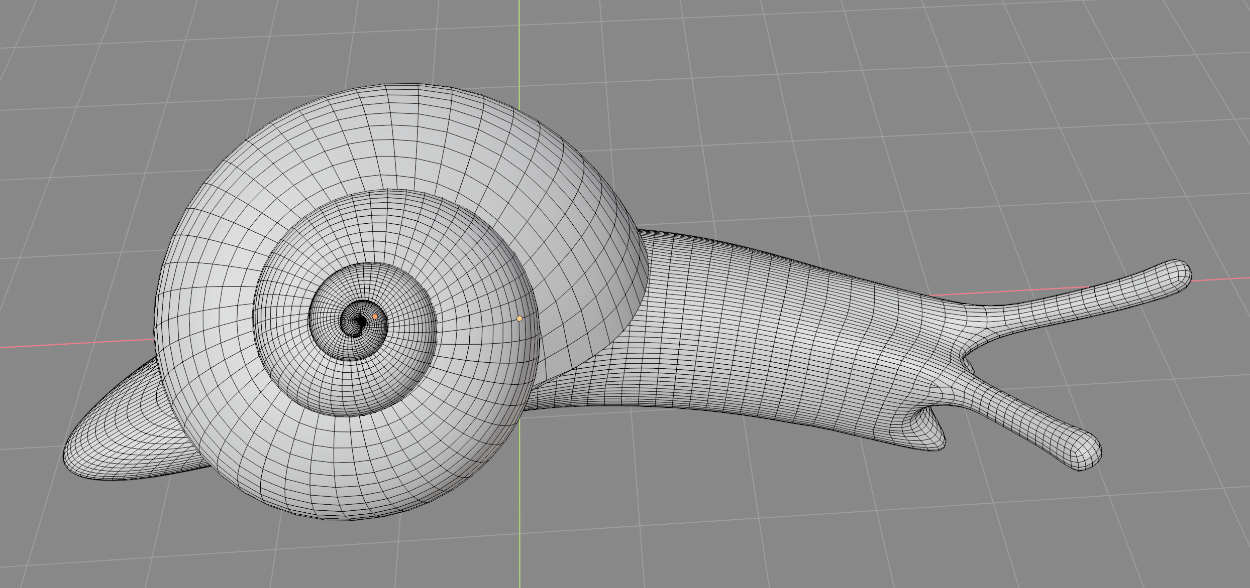
My first attempt was to just get a good snail shell shape out of plain wood. I used VCarve's two-sided carving option and made sure there was a good solid tab on the 'opening' of the shell, where I could cut it off with a saw and file it flat. The rest of the shell would then be smooth and nice. My first successful carve made a fairly flat shell. There are shells in the garden similar to this, but I wanted the more common very round garden snail shell. So I tried again. I got some good results!
I wanted to see if I could use textures and colours of wood to create the banding and spiral patterns that snail shells have. I tried with a piece of construction plywood I had, and while I really like how it looks and feels I thought it was a bit messy for what I was after. I'll definitely do this again but with a cleaner, nicer bit of plywood.
The next thought was to effectively make my own plywood, but with a spiral structure built in. So I would create layers of wood in alternating colours, cut to the varying thickness I needed for the shell pattern, glue them together and then align it just-so to carve the whole shell out of it.
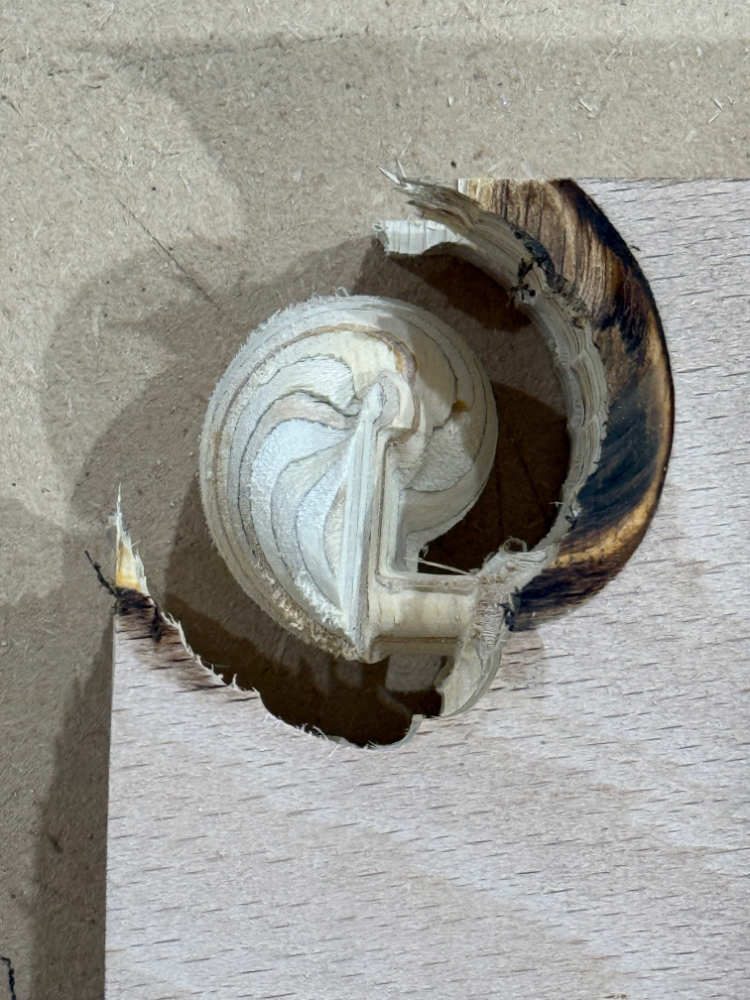
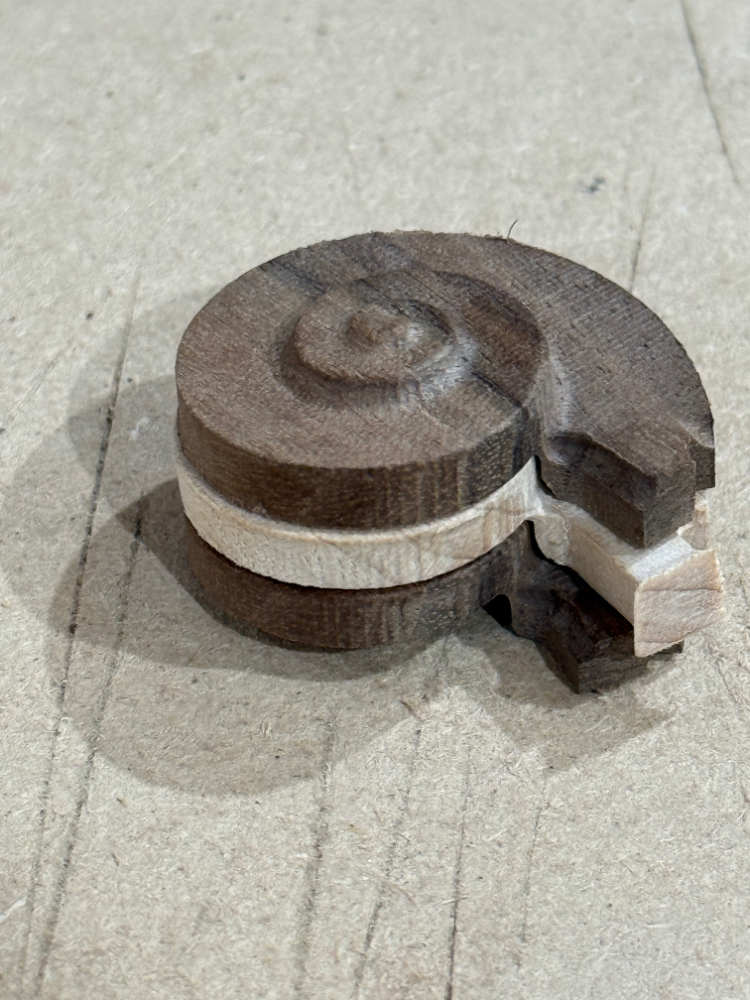
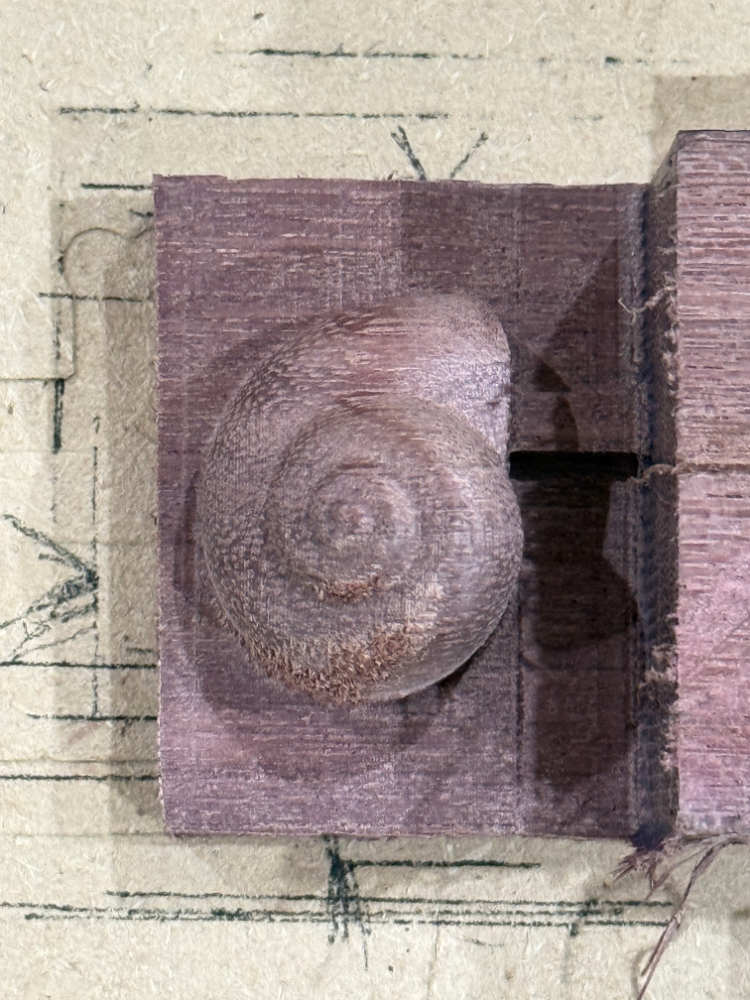
I still think this appreach has a lot of promise. The issues are several. The pieces need to be precisely sized to fit together with no gaps, but enough gap to allow for glue and for the layers to bend slightly to conform to the internal snail shell structure (I am not half-arseing this). Also once the layers are glued together I need to position it and angle it right for the CNC to carve the shell shape. I tried carving one by hand and… nope. It's possible, but fiddly, and too easy to screw it up (reader, I screwed it up). So, I made precisely ONE. It didn't turn out very good. BUT. Again, it's something I see promise in. I think I'd like to try again, but making a big shell, maybe 4cm across.
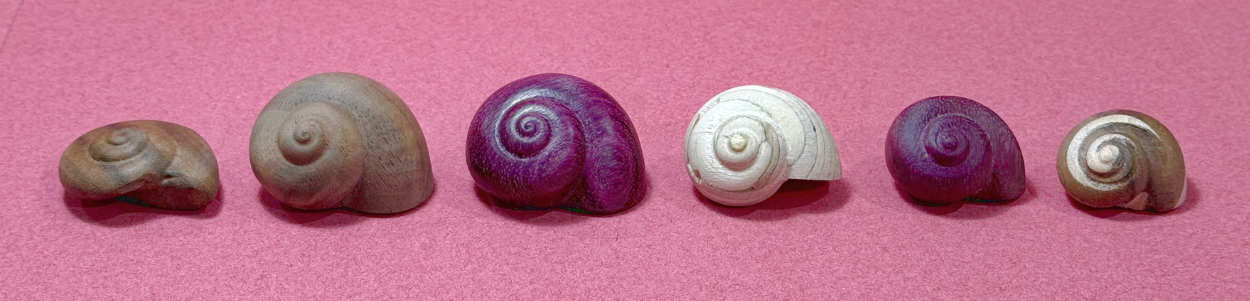
So, in the end I used solid wood. I tried with a nice piece of walnut burr, and it's a beautiful thing. I made one in walnut, which is also lovely. I made another out of purple heart wood and this was gorgeous, so that's the one I used in the end.
Snail bodies
Now this… this was where I've learned some stuff, both in Blender and CNC. Thousand yard stare moment.
I mentioned above using VCarve's two-sided carving option. This is where I put it to the test to do… three sided carving. This is because a snail body is rounded, curved and has eyes that stick out, and to carve them with a machine that can only do one direction at once you need to have more than two directions to approach from. I got a system that actually did work, making a 3D model in Blender that had a cube as a 'base' that could be precisely positioned within the material bounds in VCarve.
The issue is… snails have eyes that STICK OUT. They're on thin stalks, and I am making a life-size model of a snail. Snails are small. Wood is strong in the direction of its grain, but those eyes, they're not always aligned like that. I have lots of broken bits of snail. Frustrating.
The solution is to carve the snail body in parts. I did one attempt carving the body as one part and the two eye stalks together as another part. That worked! I tried doing it again. It broke. Again. It broke. Natural materials!
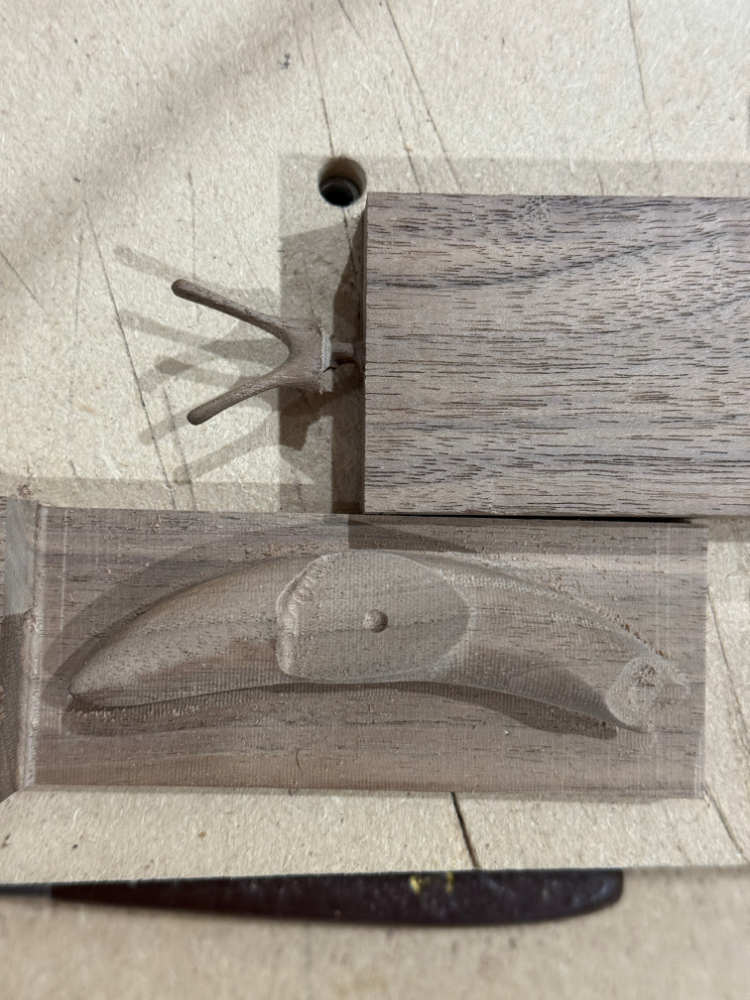
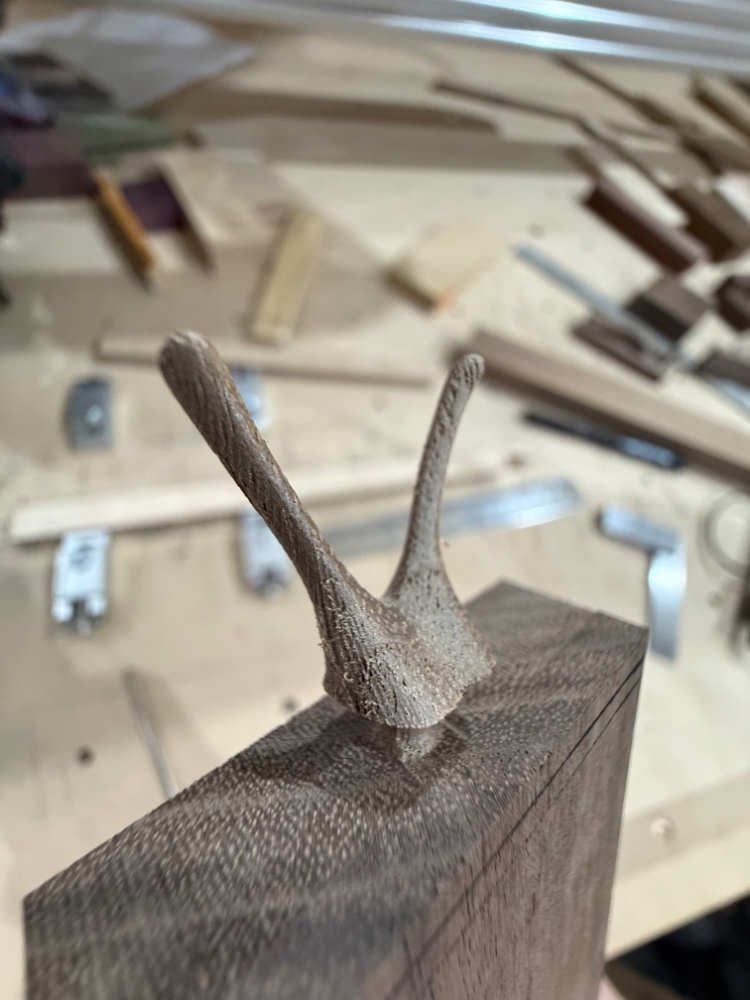
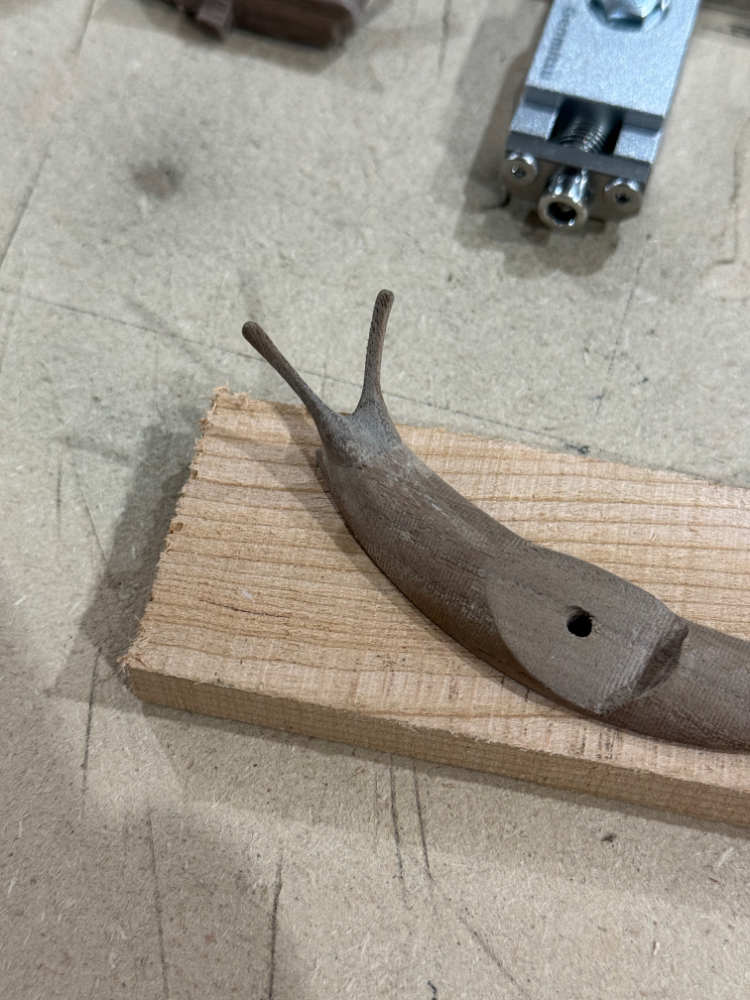
So, model it as more separate parts, aligning the thin bits more exactly with the grain. A couple of failures, and then at last! Success! One snail I made in three parts cut one way (eyes, body and shell) and a second with two body halves (with eyes in situ) and the shell. I was very pleased with them.
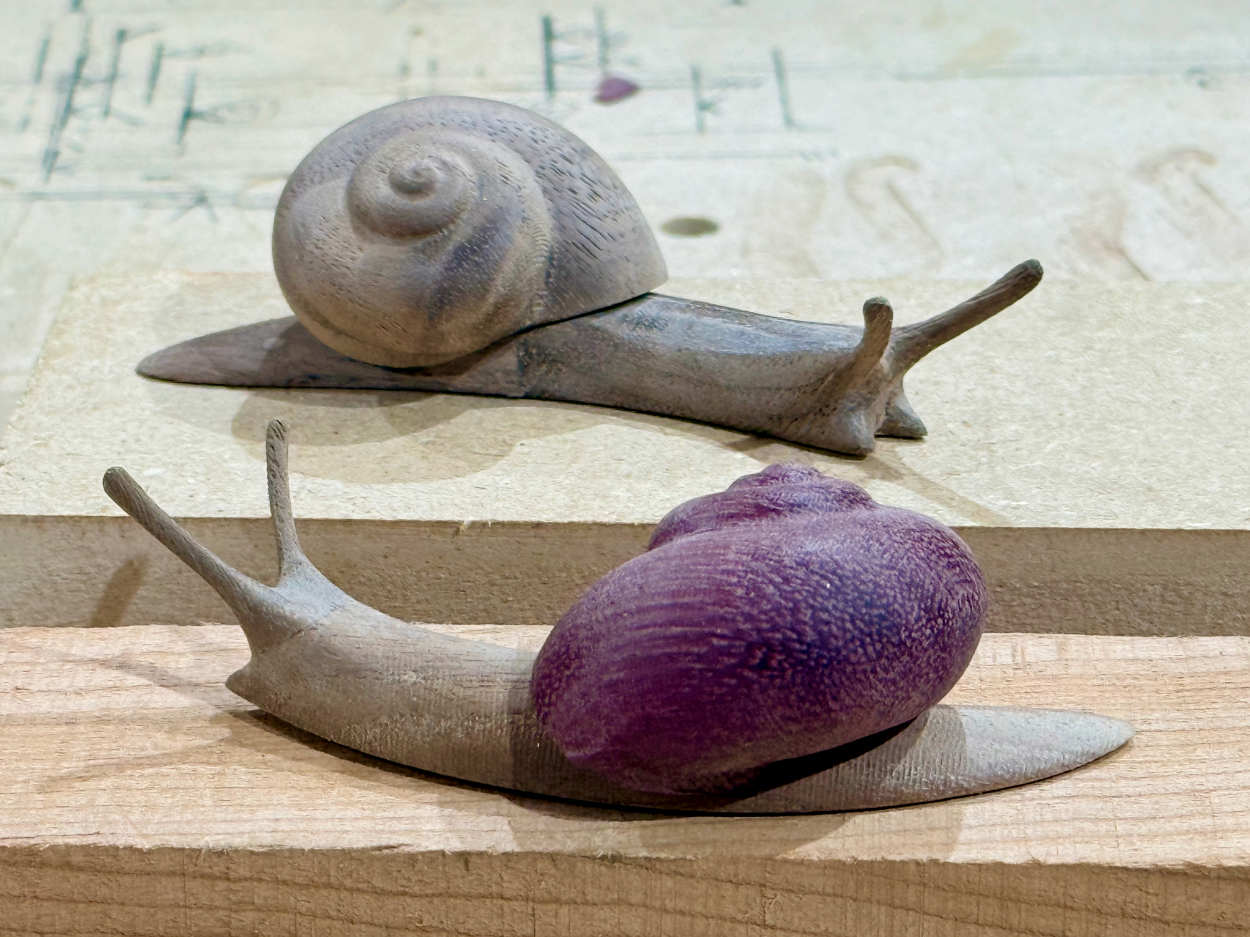
So, in the end, I had two complete snail bodies and three good snail shells to use with them. I would use one snail for the drawer knob, and keep the other, I'll probably put it under a glass cover to keep it safe because it's a precious thing. It's given me a much deeper appreciation of snails now. Honestly, if you really want to appreciate something, try and make a model of it. In a very scary procedure I drilled a hole in both snails from the underside to take a dowel. The hole goes through the body and into the shell, and the dowel is glued inside. It adds strength and stability to the snail for use as a drawer pull.
Flowers and leaves
The other drawer knob is a flower. I thought about carving this as a single piece, but I wanted the wood grain to go along the direction of each petal. The issue here was less about modelling and carving and more about the materials I had available. I wanted to make the flower out of pink ivory wood. It's a rare and beautiful wood that is pink right in the centre of the tree, so there's not much of it that is actually pink. Most of it you can buy comes in small pieces to make pens out of. I later found out it fades if you expose it to light and oxygen, so I need to treat it with UV protection.
Just one flower? No leaves? That doesn't sound very rococo?
A cautionary tale for me, this. I had quite a few ideas on creating a design with leaves and flowers, which I should have done right back at the start before I did the snail. I was essentially retrofitting a design around an existing element (the snail) rather than doing something fresh.
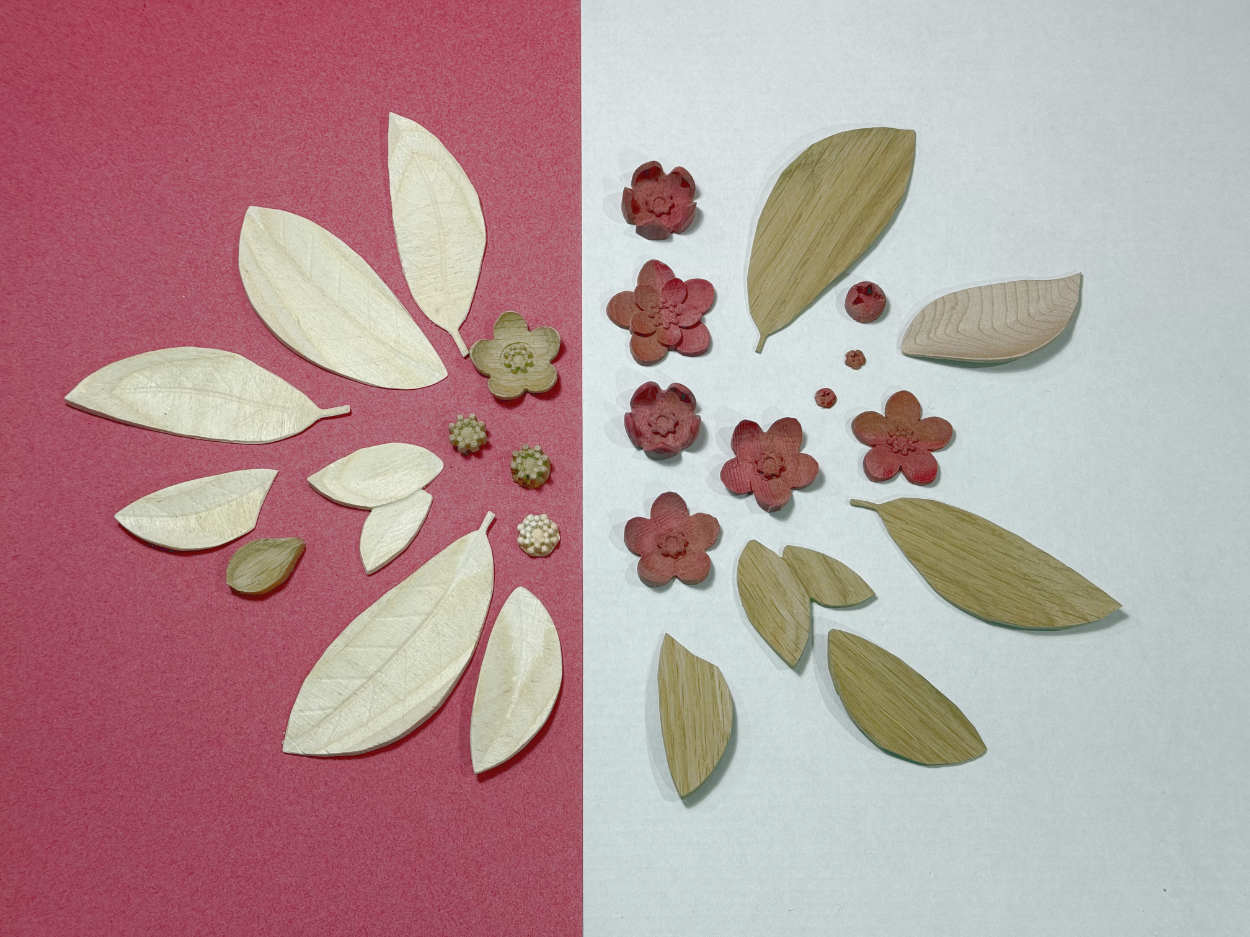
I learned some new things in Blender that helped me make the leaves, and I made several designs with leaves and flowers. I have quite a few leaves made out of wood now that I would like to use on something. I made some leaves out of oak, plywood and maple. I ended up using the ones in maple as the light colour and wood grain worked really well with the rest of the box and the pink flowers.
I also made a few sets of little flowers to support the larger drawer pull flower. I'm quite pleased with how these turned out too. Pink ivory is fragile though. This isn't a box that is designed for any kind of heavy use!
I tried many different layouts of leaves and flowers. I originally intended for leaves to go across both drawer fronts and to use a very narrow kerfed saw to cut them apart. In the end I didn't do this as I felt it was taking a risk too far, I'd already attached the snail and large flower!
The result
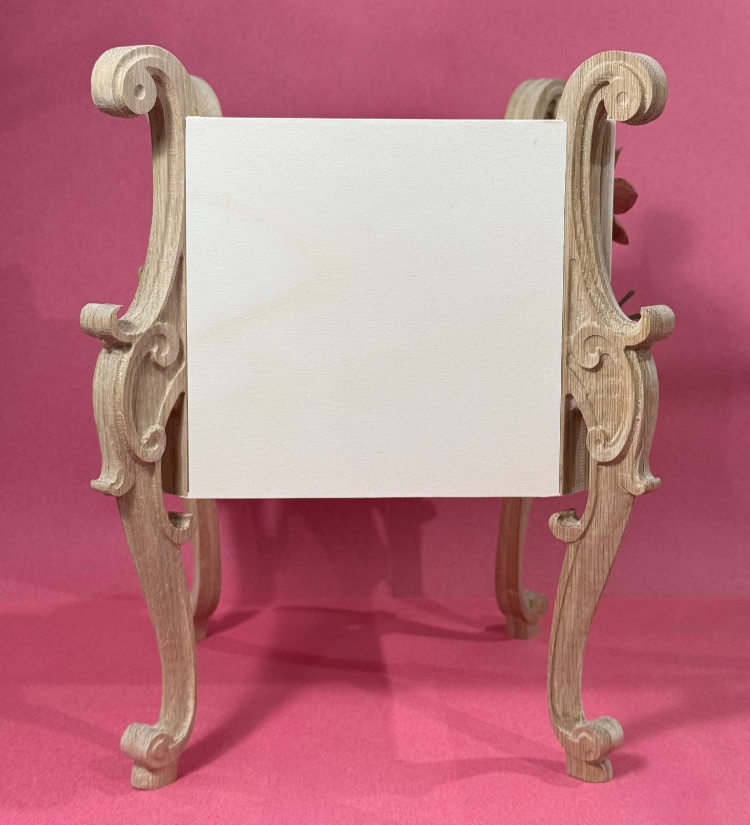
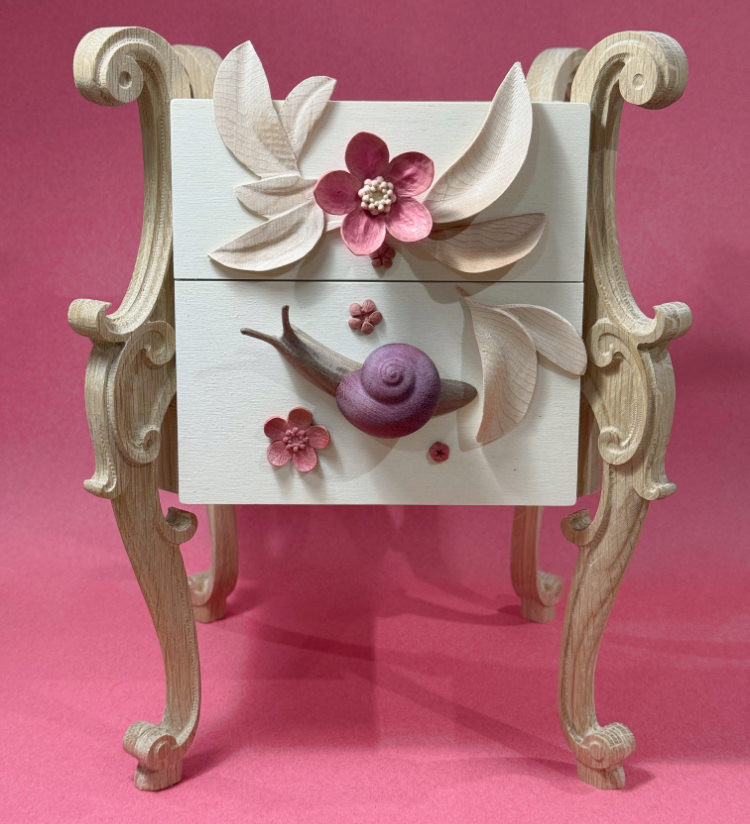
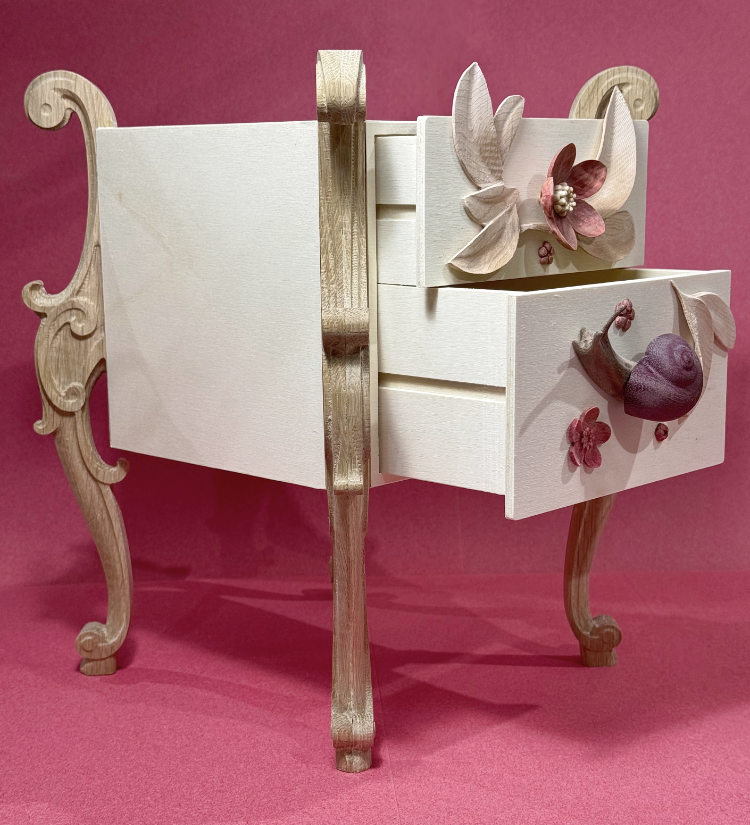
The end result was not what I would think of as a rococo design and I think I would do something more integrated and fluent if I was to do it now, but I am still pleased with it. It taught me a lot.